

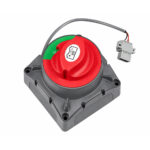


BEP 701-MD Remote Operated Marine Battery Switch – 275A, 9.5–32V
د.إ 725.00
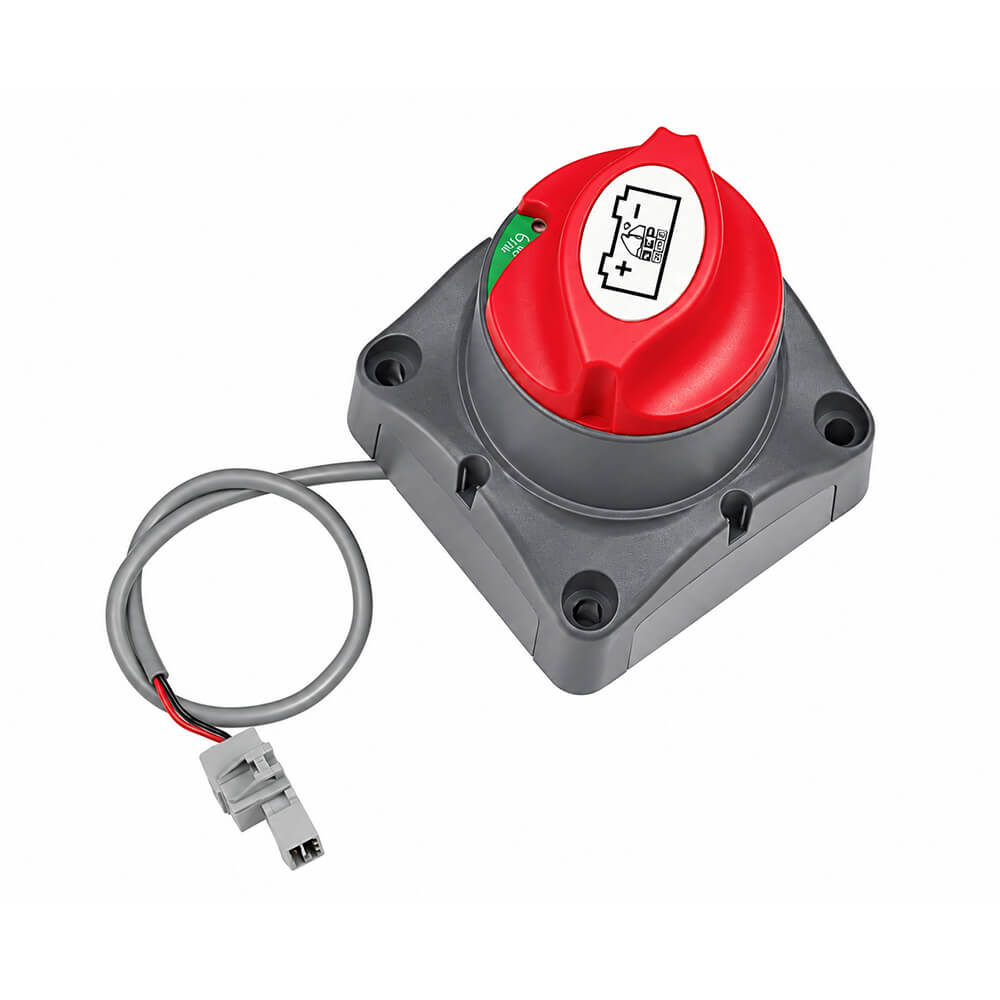
The BEP 701-MD Remote Operated Marine Battery Switch – 275A, 9.5–32V provides remote On/Off battery control for boats and yachts. Mount it close to the battery to shorten heavy cable runs and reduce cable weight and installation work.
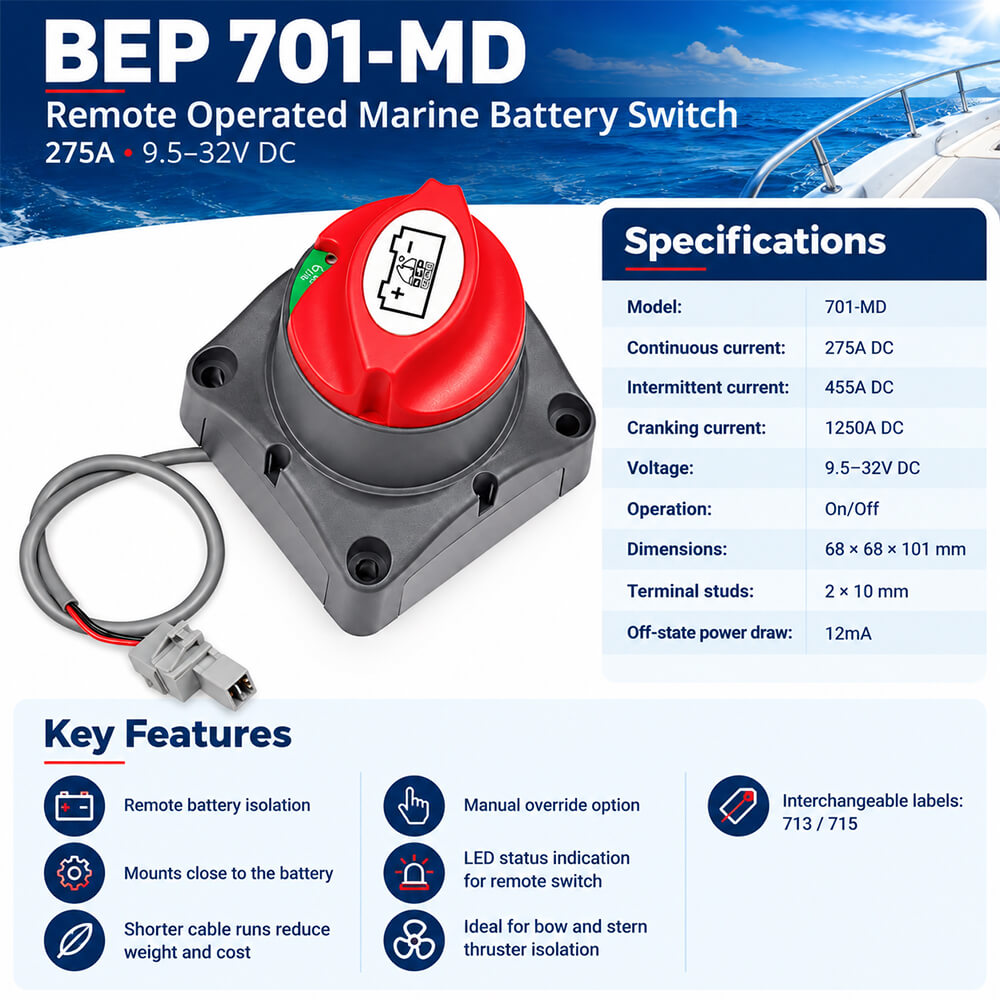
- Current ratings: 275A continuous, 455A intermittent, and 1,250A cranking.
- Voltage range: 9.5–32V DC.
- Control: Remote operation with manual override and LED status indication.
- Applications: Marine battery isolation, including bow and stern thruster circuits.
- Connections: Two 10 mm terminal studs.
BEP 701-MD Remote Operated Marine Battery Switch – 275A, 9.5–32V is a motorised On/Off battery switch designed to provide remote control of a boat’s battery connection. It allows the main switch to be installed close to the battery while battery switching is managed from a separate control location. This arrangement is useful when the battery compartment is away from the helm or when direct access to the switch is inconvenient. Designed for marine DC electrical systems, this BEP battery switch supports practical battery isolation without requiring long, heavy battery cables to reach a manually operated switch at the control position.
The BEP 701-MD has a 275A continuous current rating, a 455A intermittent current rating, and a 1,250A cranking current rating. These ratings describe different operating conditions and should be considered separately when selecting a marine battery switch. The continuous rating applies to sustained electrical loads, while the intermittent and cranking ratings cover shorter periods of higher current. Its listed voltage range is 9.5–32V DC, and its switching function is On/Off. Buyers should match the switch to the vessel’s electrical system, connected equipment, and current requirements, rather than choosing it solely by the highest current figure.
Installing this remote battery disconnect switch alongside the battery helps shorten the heavy cable runs required for battery switching. Depending on the installation layout, this can reduce the amount, weight, and cost of copper battery cable, while also reducing installation work associated with routing longer cables. The manufacturer identifies remote isolation of bow and stern thrusters as a key application. For vessels where thruster batteries are positioned away from the main operating station, remote switching provides a practical way to manage the battery connection while keeping the high-current switching hardware close to the battery. Cable selection must still suit the connected load and installation requirements.
The switch includes a manual override option and supports LED status identification at the remote control switch. Manual override provides local control of the switching mechanism, while status indication helps the operator identify the switch condition from the remote position. It also uses BEP’s interchangeable labelling system, allowing the battery switch function to be identified within the vessel’s electrical layout. The supplied product information references label items 713 or 715. Whether selected for a new installation or an electrical refit, this boat battery switch combines remote operation with clearly defined current ratings and local manual control.
Key Features:
- BEP 701-MD Remote Operated Marine Battery Switch – 275A, 9.5–32V provides motorised On/Off battery switching, allowing the main unit to sit near the battery while control is located elsewhere on the vessel.
- Defined DC current capacity: Rated at 275A continuous, 455A intermittent and 1,250A cranking, helping buyers assess suitability for sustained loads and short-duration current demands.
- Battery-side installation: Mounting close to the battery can shorten heavy cable runs and reduce copper cable requirements, installation labour, and cable weight.
- Manual override: Provides a local means of operating the switch in addition to remote control.
- Remote status indication: Supports LED indication at the remote control switch for checking the switching condition.
- Mounting and connections: BEP’s catalogue lists surface or recessed mounting, two 10 mm terminal studs, tin-plated copper studs and nuts, and dimensions of 69 × 69 × 101 mm.
- Off-state consumption: The manufacturer’s catalogue lists a 15 mA draw with the 701-MD switched off.
Applications / Suitable For:
- BEP 701-MD Remote Operated Marine Battery Switch – 275A, 9.5–32V is suitable for marine battery isolation applications where remote On/Off control is required and the electrical load falls within its specified ratings.
- Bow and stern thruster battery circuits: Intended for remote isolation arrangements that place the battery switch close to the thruster battery.
- Boats and yachts with separate battery compartments: Useful where the battery location makes direct access to a conventional manual switch inconvenient.
- Marine electrical refits: Suitable for layouts being revised to shorten battery switching cable runs and improve access to battery control.
- New vessel electrical installations: Provides an option for positioning the main battery switch near the battery while planning a separate remote control location.
- Identified battery circuits: The interchangeable labelling system helps distinguish the switch’s assigned function within the onboard electrical arrangement.
FAQs:
Q: What does the BEP 701-MD Remote Operated Marine Battery Switch – 275A, 9.5–32V do?
A: It remotely switches a marine battery connection on or off, allowing the main switching unit to be installed close to the battery.
Q: Is 1,250A the continuous current rating?
A: No. The continuous rating is 275A. The 1,250A figure is the cranking rating, while the intermittent rating is 455A.
Q: Can the switch be operated manually?
A: Yes. The 701-MD includes a manual override option for local operation in addition to its motorised remote switching function.
Q: Does the BEP 701-MD include an optical sensor?
A: No. BEP identifies the optical sensor feature with the 720-MDO model. The 701-MD is the motorised remote On/Off battery switch described here









 Fishing Lights